
The 7 Hidden Interview Questions Every Job Seeker Must Know
The 7 Hidden Interview Questions Every Job Seeker Must Know
Walking into a job interview can feel like stepping onto a stage where you’re expected to deliver a flawless performance. You’ve rehearsed your answers, polished your resume, and researched the company. But here’s the truth that most candidates miss: the questions interviewers ask aren’t always what they seem. Behind every common interview question lies a hidden agenda, a deeper concern about your capability, motivation, and cultural fit.
Understanding these hidden interview questions is the difference between giving generic, forgettable answers and positioning yourself as the solution to their problems. This comprehensive guide will decode the seven most common interview questions, reveal what hiring managers are really assessing, and provide you with winning formulas to stand out from the competition.
Understanding the Iceberg Principle of Interview Questions
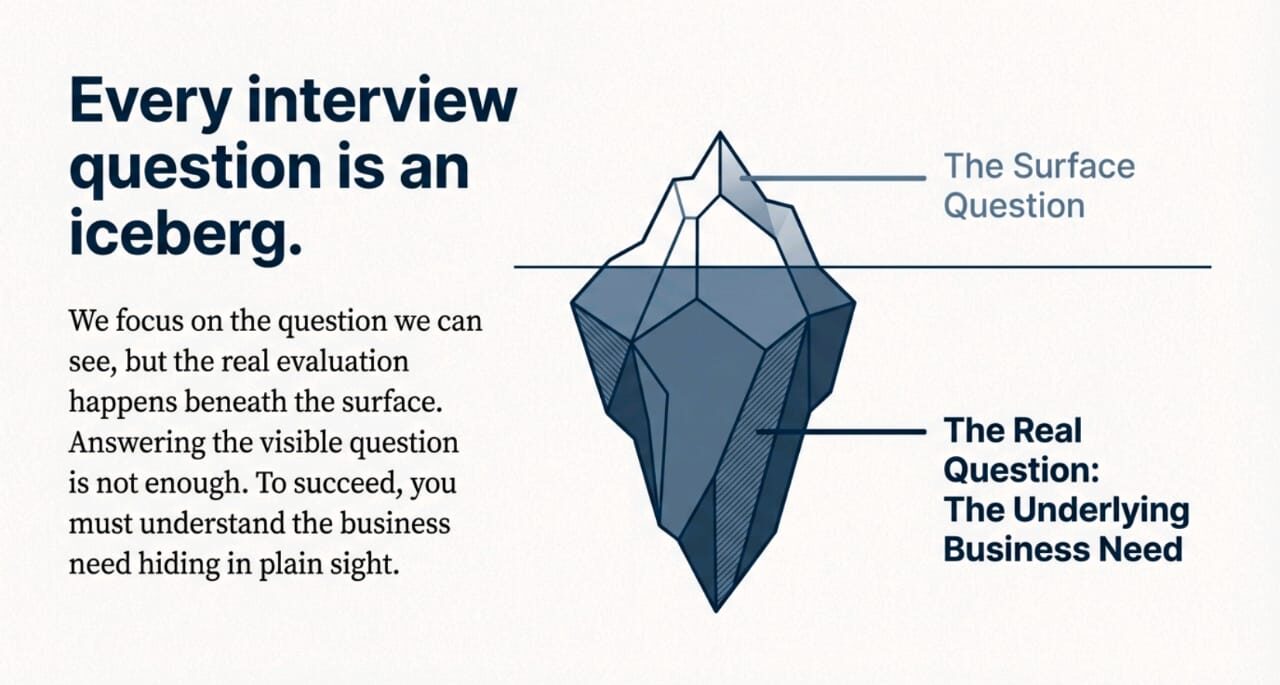
Every interview question is like an iceberg. What you see on the surface is just a small fraction of what lies beneath. Interviewers focus on the visible question, but the real evaluation happens at a deeper level, where they’re assessing your capability, motivation, and overall fit for the role.
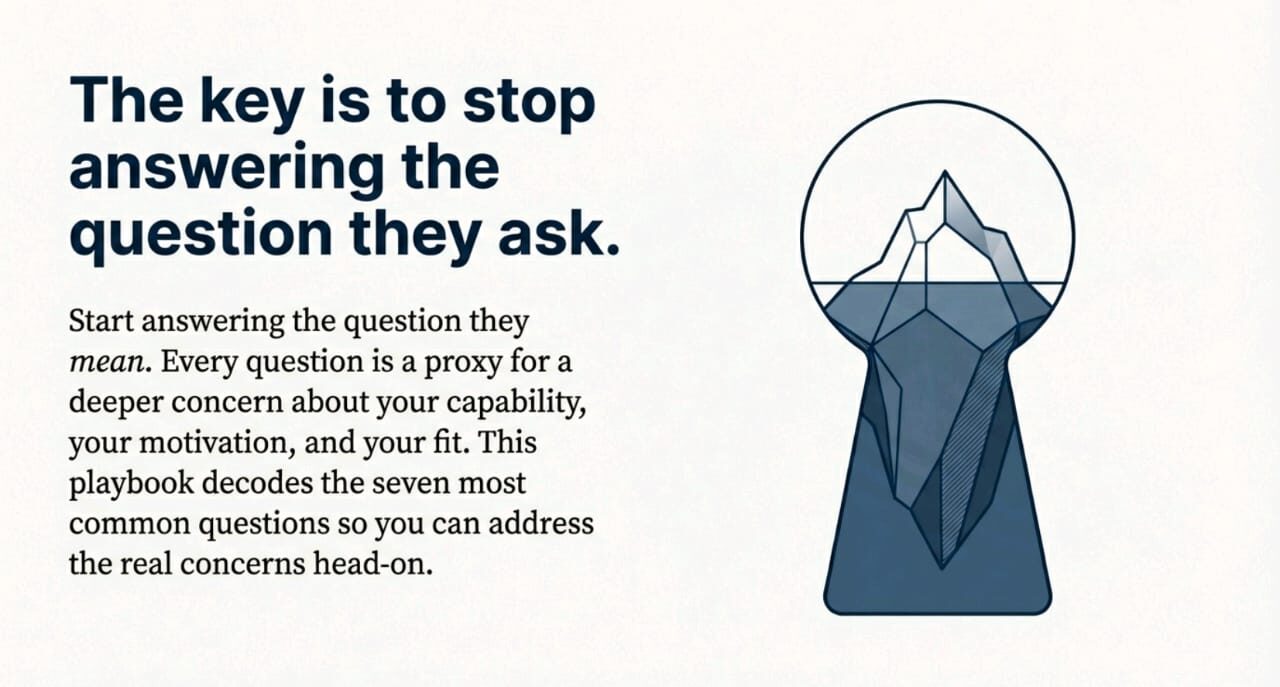
The most successful candidates don’t simply answer the question they’re asked. Instead, they answer the question the interviewer means. This requires shifting your mindset from being “someone looking for a job” to becoming “the solution to their problem.” When you make this mental shift, everything changes. You stop memorizing scripts and start solving business challenges.
Before we dive into the seven questions, it’s crucial to ensure your resume positions you as this problem-solver from the start. A professionally crafted resume can open doors before you even speak a word. Services like Resume.io offer AI-powered resume builders that help you highlight your achievements in ways that resonate with hiring managers, while TopResume provides professional resume writing services that can transform your career story into a compelling narrative.
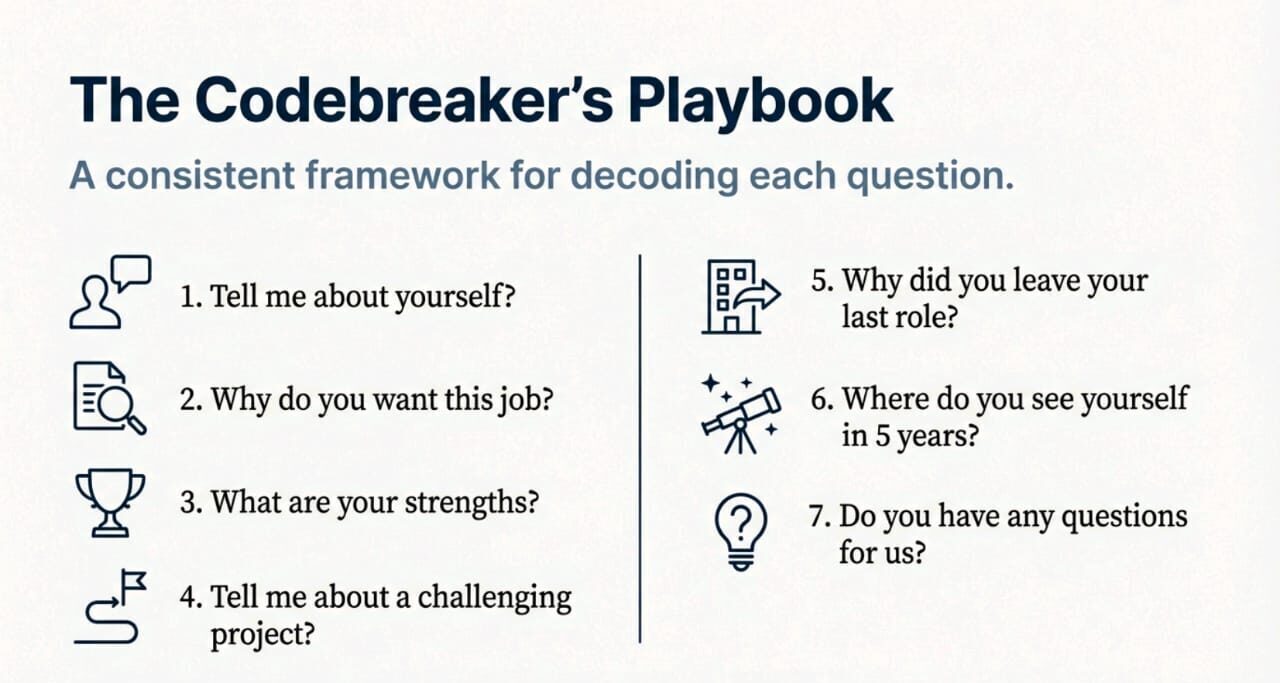
Hidden Interview Question #1: “Tell Me About Yourself”
The Surface Question
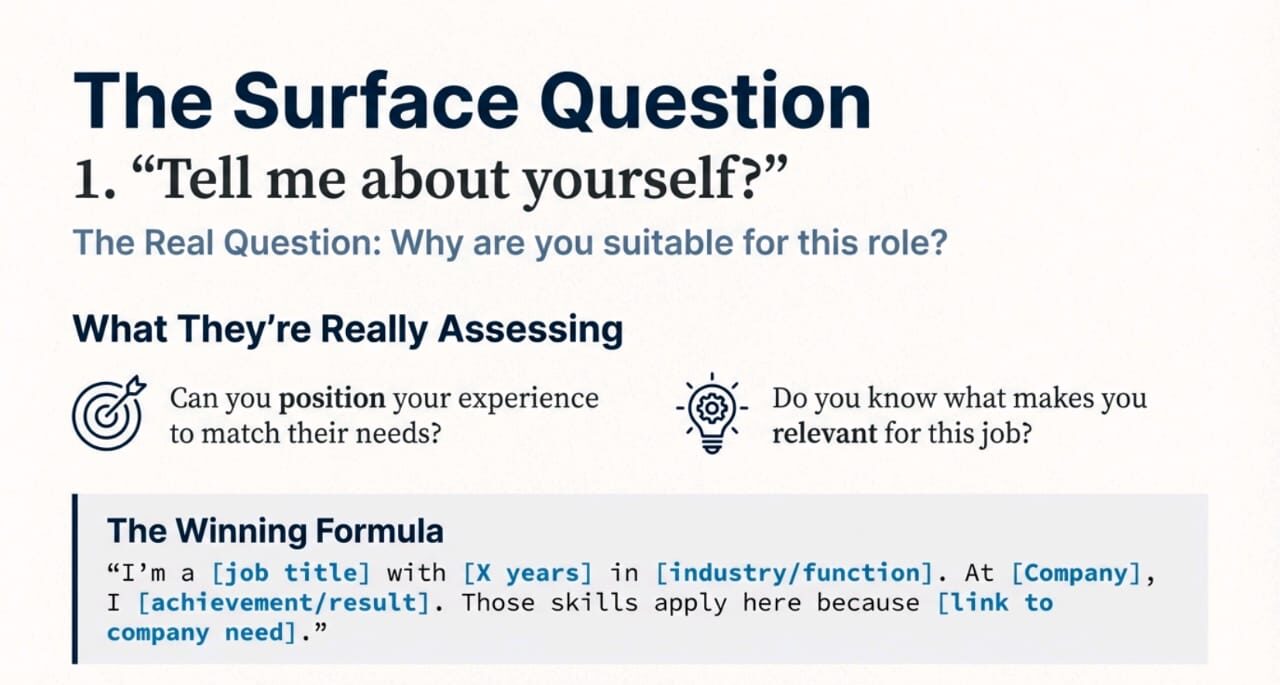
On the surface, this seems like an easy icebreaker. Interviewers want you to talk about your background, right?
The Real Question: Why Are You Suitable for This Role?
When hiring managers ask you to introduce yourself, they’re really assessing whether you can position your experience to match their needs. They want to know if you understand what makes you relevant for this specific job.
What They’re Really Assessing:
- Can you position your experience to match their needs?
- Do you know what makes you relevant for this job?
The Winning Formula
Structure your answer like this: “I’m a with [X years] in [industry/function]. At [Company], I [achievement/result]. Those skills apply here because [link to company need].”
For example: “I’m a digital marketing manager with seven years of experience in the e-commerce sector. At my previous company, I increased online sales by 45% through strategic SEO and content marketing campaigns. Those skills directly align with your goal of expanding your digital presence in the competitive retail space.”
This formula immediately establishes your credibility, demonstrates results, and shows you understand their business needs. Your resume should echo this narrative. If you’re unsure whether your resume effectively tells this story, consider getting a professional review from TopCV, which offers expert feedback on how to better position your experience.
Hidden Interview Question #2: “Why Do You Want This Job?”
The Surface Question
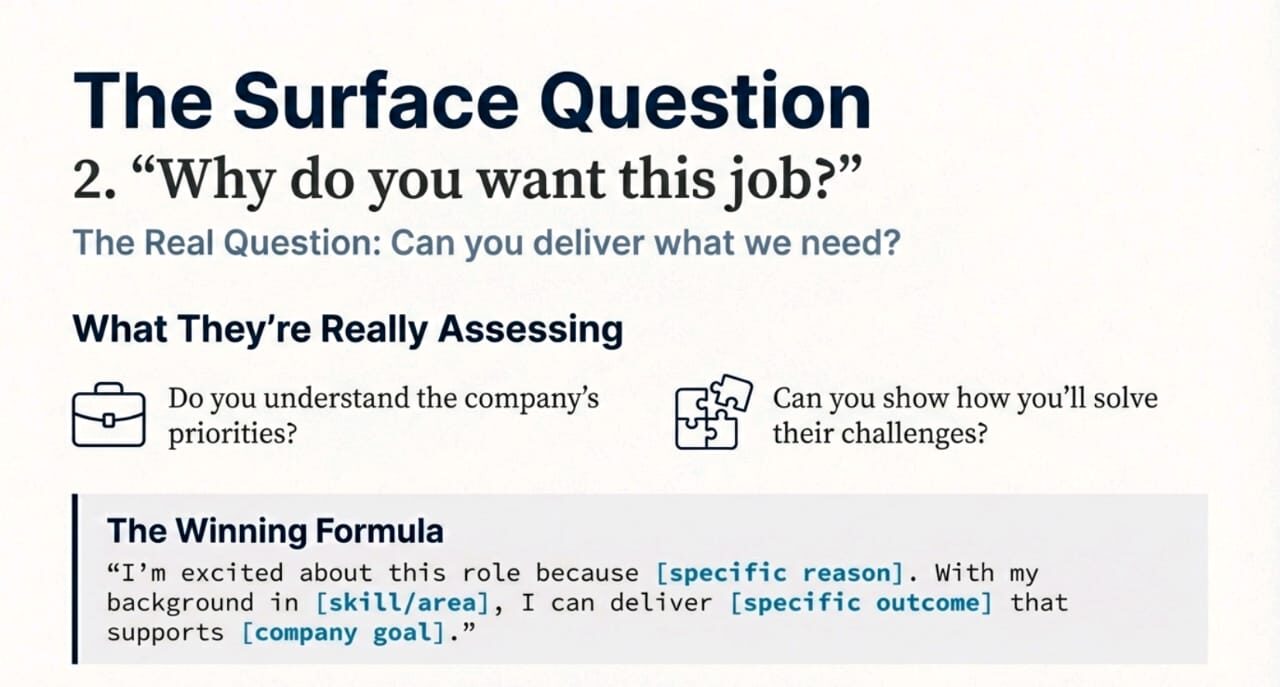
It sounds like they’re asking about your motivations and career interests.
The Real Question: Can You Deliver What We Need?
Interviewers aren’t just interested in what excites you. They want to know if you understand their priorities and whether you can demonstrate how you’ll solve their specific challenges.
What They’re Really Assessing:
- Do you understand the company’s priorities?
- Can you show how you’ll solve their challenges?
The Winning Formula
Use this structure: “I’m excited about this role because [specific reason]. With my background in [skill/area], I can deliver [specific outcome] that supports [company goal].”
For example: “I’m excited about this role because it combines customer experience optimization with data analytics, two areas where I’ve driven significant results. With my background in UX design and customer journey mapping, I can deliver improved conversion rates and customer satisfaction scores that support your goal of becoming the market leader in customer retention.”
This answer moves beyond generic enthusiasm and positions you as someone who can deliver measible business value. Notice how the response connects personal skills with company outcomes. This strategic thinking should also be reflected in your resume. Professional services like TopStack Resume specialize in helping tech professionals and others craft resumes that highlight this strategic, results-oriented mindset.
Hidden Interview Question #3: “What Are Your Strengths?”
The Surface Question
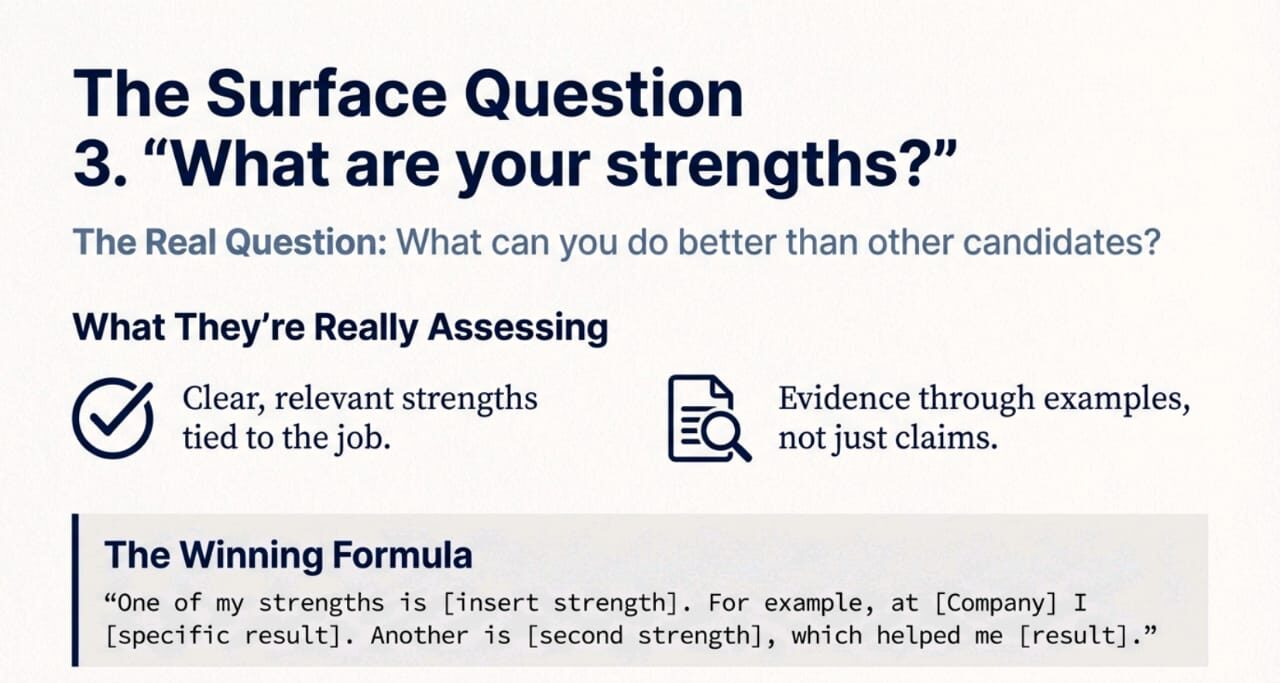
This appears to be an invitation to list your positive qualities.
The Real Question: What Can You Do Better Than Other Candidates?
When interviewers ask about strengths, they’re conducting a comparative analysis. They’re not just interested in what you’re good at—they want to know what makes you uniquely valuable compared to other candidates.
What They’re Really Assessing:
- Clear, relevant strengths tied to the job
- Evidence through examples, not just claims
The Winning Formula
Structure your response like this: “One of my strengths is [insert strength]. For example, at [Company] I [specific result]. Another is [second strength], which helped me [result].”
For example: “One of my strengths is strategic problem-solving under pressure. For instance, when our main supplier failed to deliver during peak season, I quickly identified alternative vendors and negotiated expedited shipping, preventing a 30% revenue loss. Another strength is cross-functional collaboration, which helped me lead a product launch that brought together engineering, marketing, and sales teams to exceed our first-quarter targets by 22%.”
This approach provides concrete evidence of your capabilities rather than vague claims. Each strength is backed by a specific achievement that hiring managers can visualize and value.
Hidden Interview Question #4: “Tell Me About a Challenging Project”
The Surface Question
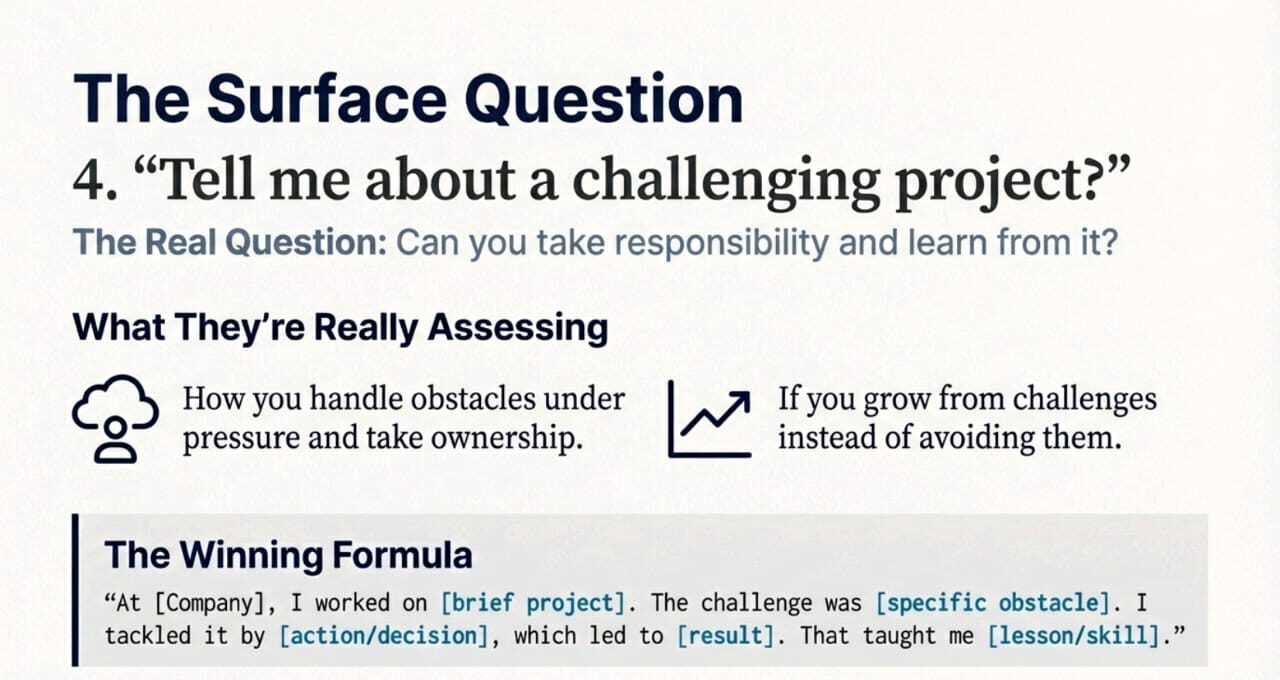
They want to hear about a difficult situation you’ve faced.
The Real Question: Can You Take Responsibility and Learn From It?
This question goes deeper than problem-solving ability. Interviewers want to know how you handle obstacles under pressure, whether you take ownership of challenges, and if you grow from difficult experiences instead of avoiding them.
What They’re Really Assessing:
- How you handle obstacles under pressure and take ownership
- If you grow from challenges instead of avoiding them
The Winning Formula
Use this framework: “At [Company], I worked on [brief project]. The challenge was [specific obstacle]. I tackled it by [action/decision], which led to [result]. That taught me [lesson/skill].”
For example: “At my previous company, I led a software migration project with a tight three-month deadline. The challenge was coordinating between five different departments while managing technical complexities none of us had encountered before. I tackled it by establishing daily stand-ups, creating a centralized communication dashboard, and bringing in an external consultant for the most technical aspects. We completed the migration two weeks early with zero downtime. That experience taught me the importance of transparent communication and knowing when to seek expertise outside the team.”
This storytelling approach demonstrates maturity, accountability, and continuous learning—all qualities that separate good candidates from great ones.
Hidden Interview Question #5: “Why Did You Leave Your Last Role?”
The Surface Question
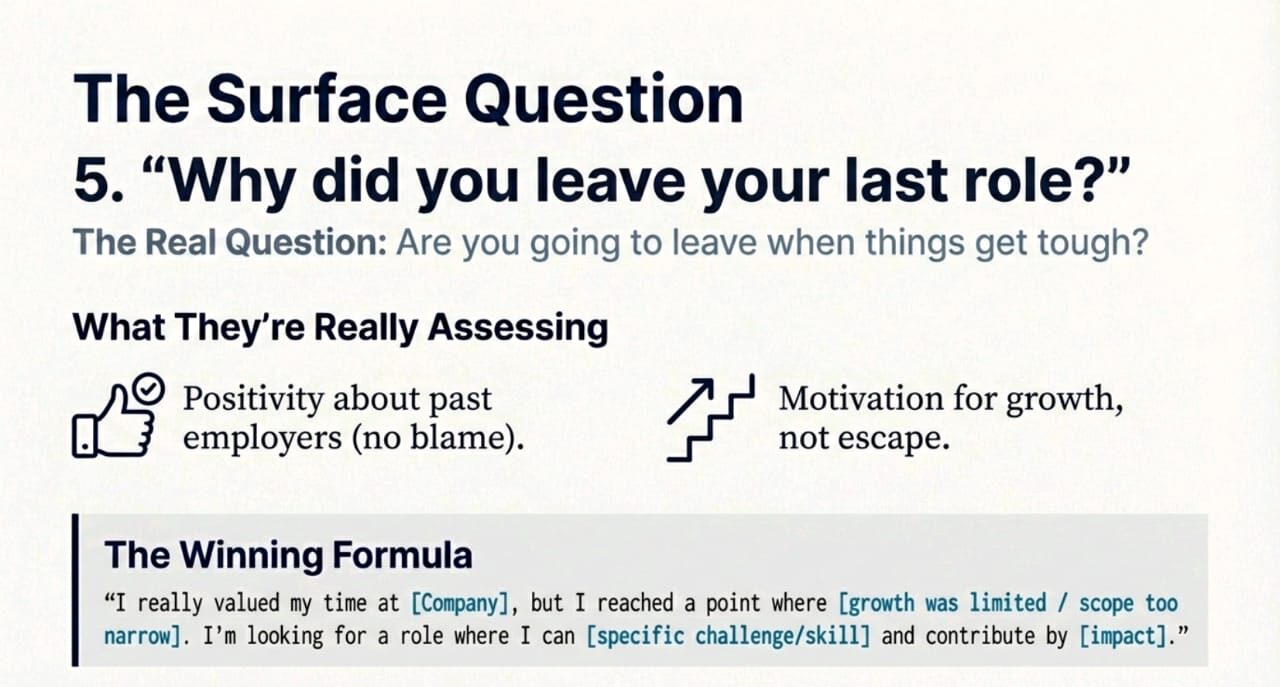
This seems like a straightforward question about your employment history.
The Real Question: Are You Going to Leave When Things Get Tough?
Hiring managers are deeply concerned about retention. They want to understand whether you left your previous role because you were running away from problems or running toward growth opportunities. This question reveals your resilience and commitment.
What They’re Really Assessing:
- Positivity about past employers (no blame)
- Motivation for growth, not escape
The Winning Formula
Frame your answer this way: “I really valued my time at [Company], but I reached a point where [growth was limited / scope too narrow]. I’m looking for a role where I can [specific challenge/skill] and contribute by [impact].”
For example: “I really valued my time at TechStart Solutions, and I learned tremendously about agile project management and stakeholder engagement. However, I reached a point where the company’s focus shifted away from enterprise clients, limiting my ability to work on large-scale implementations. I’m looking for a role where I can leverage my experience with complex, multi-stakeholder projects and contribute by driving digital transformation initiatives that create measurable business value.”
This response demonstrates gratitude for past experiences while articulating a clear, growth-oriented reason for the transition. It never criticizes former employers and instead focuses on your aspirations.
Hidden Interview Question #6: “Where Do You See Yourself in 5 Years?”
The Surface Question
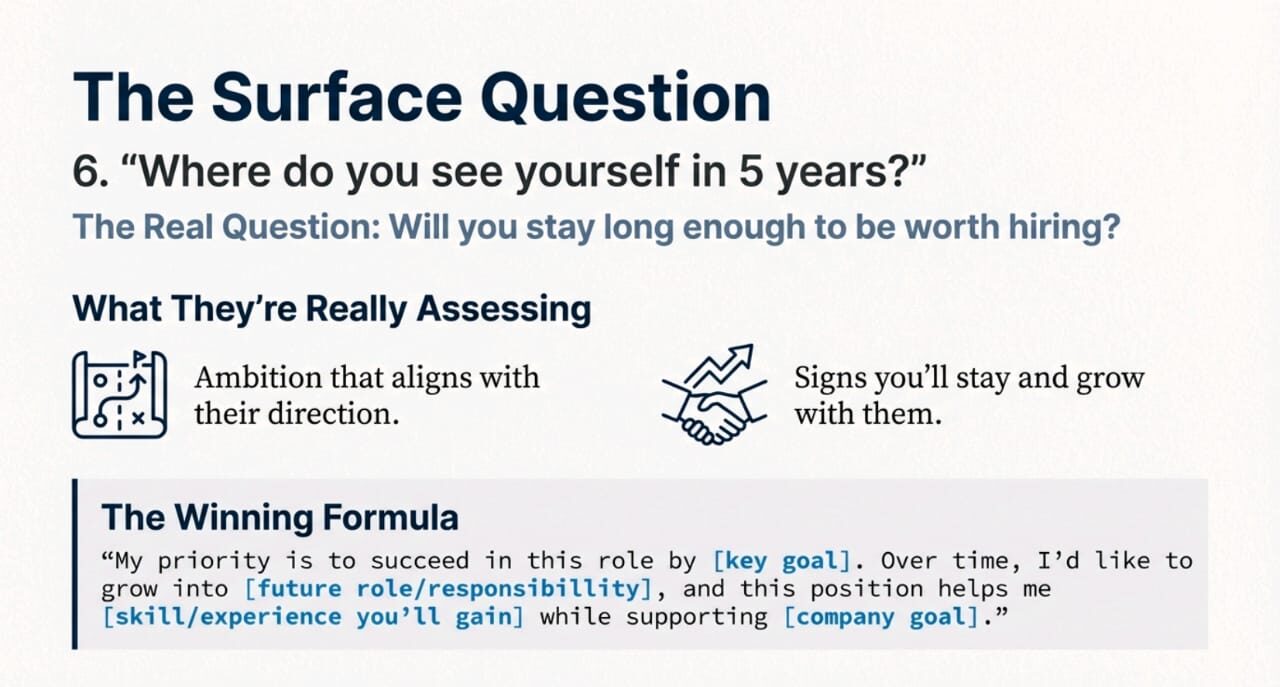
They’re asking about your long-term career goals.
The Real Question: Will You Stay Long Enough to Be Worth Hiring?
This question isn’t about predicting the future. Hiring managers want to know if your ambitions align with the company’s direction and whether you’ll stay long enough to justify the investment in hiring and training you.
What They’re Really Assessing:
- Ambition that aligns with their direction
- Signs you’ll stay and grow with them
The Winning Formula
Structure your response this way: “My priority is to succeed in this role by [key goal]. Over time, I’d like to grow into [future role/responsibility], and this position helps me [skill/experience you’ll gain] while supporting [company goal].”
For example: “My priority is to succeed in this marketing manager role by driving customer acquisition and building a high-performing content team. Over time, I’d like to grow into a director-level position where I can shape broader marketing strategy and mentor emerging talent. This position helps me develop both the strategic and leadership skills I’ll need while supporting your expansion into new markets over the next several years.”
This answer demonstrates ambition balanced with commitment. It shows you’ve thought about your career trajectory in relation to the company’s future, not just your own.
Before heading into any interview, make sure your resume reflects this same strategic thinking about your career progression. A well-structured resume that shows clear career development can reinforce everything you say in the interview. Resume.io offers templates specifically designed to showcase career progression, while TopResume can help you craft a narrative that demonstrates forward-thinking career planning.
Hidden Interview Question #7: “Do You Have Any Questions for Us?”
The Surface Question
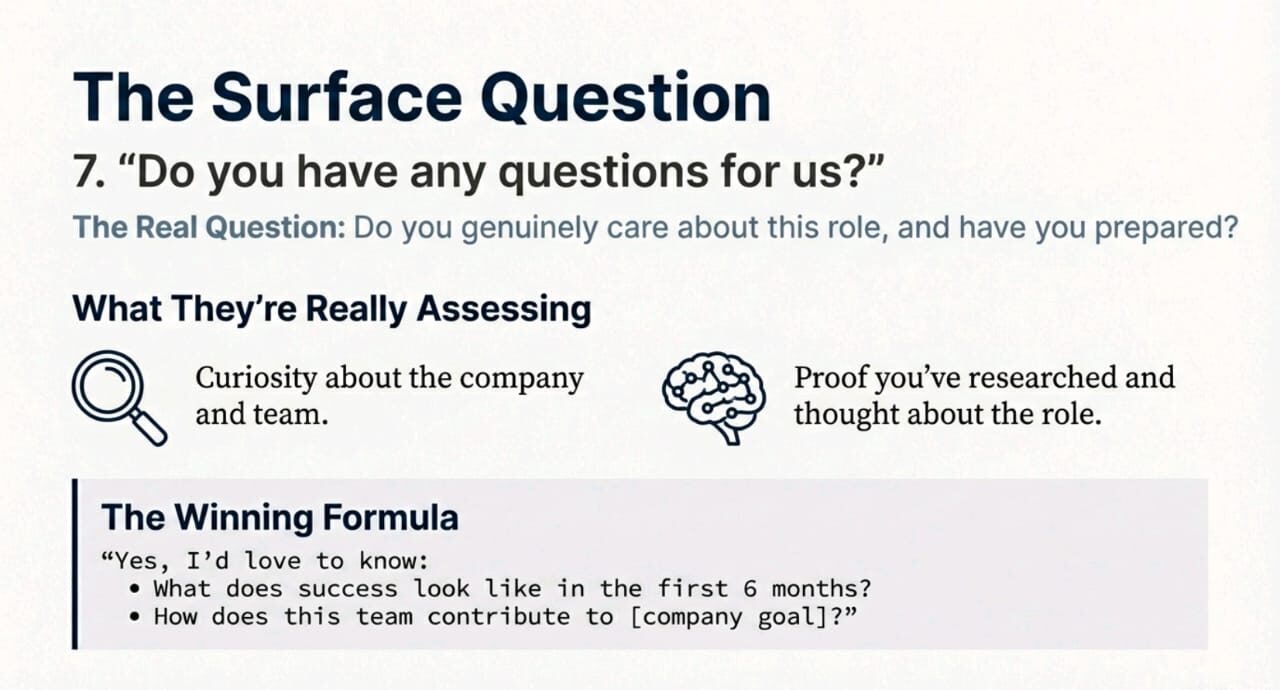
This seems like a polite way to end the interview and give you a chance to learn more.
The Real Question: Do You Genuinely Care About This Role, and Have You Prepared?
This final question is far more revealing than most candidates realize. The questions you ask demonstrate your curiosity about the company and team, and they provide proof that you’ve researched and thought deeply about the role.
What They’re Really Assessing:
- Curiosity about the company and team
- Proof you’ve researched and thought about the role
The Winning Formula
Ask questions like these: “Yes, I’d love to know: What does success look like in the first 6 months? How does this team contribute to [company goal]?”
Other strong questions include:
- “What are the biggest challenges facing this department right now?”
- “How do you measure success for this role?”
- “What opportunities for professional development does the company offer?”
- “Can you tell me about the team I’d be working with?”
These questions shift the dynamic from you being evaluated to you evaluating whether this opportunity is the right fit. They demonstrate that you’re a serious professional who thinks strategically about career decisions.
Avoid questions that focus solely on benefits, vacation time, or what the company can do for you. While these are important, they shouldn’t be your primary focus in the initial interview. Save those for later conversations or after you receive an offer.
The Mindset Shift That Changes Everything
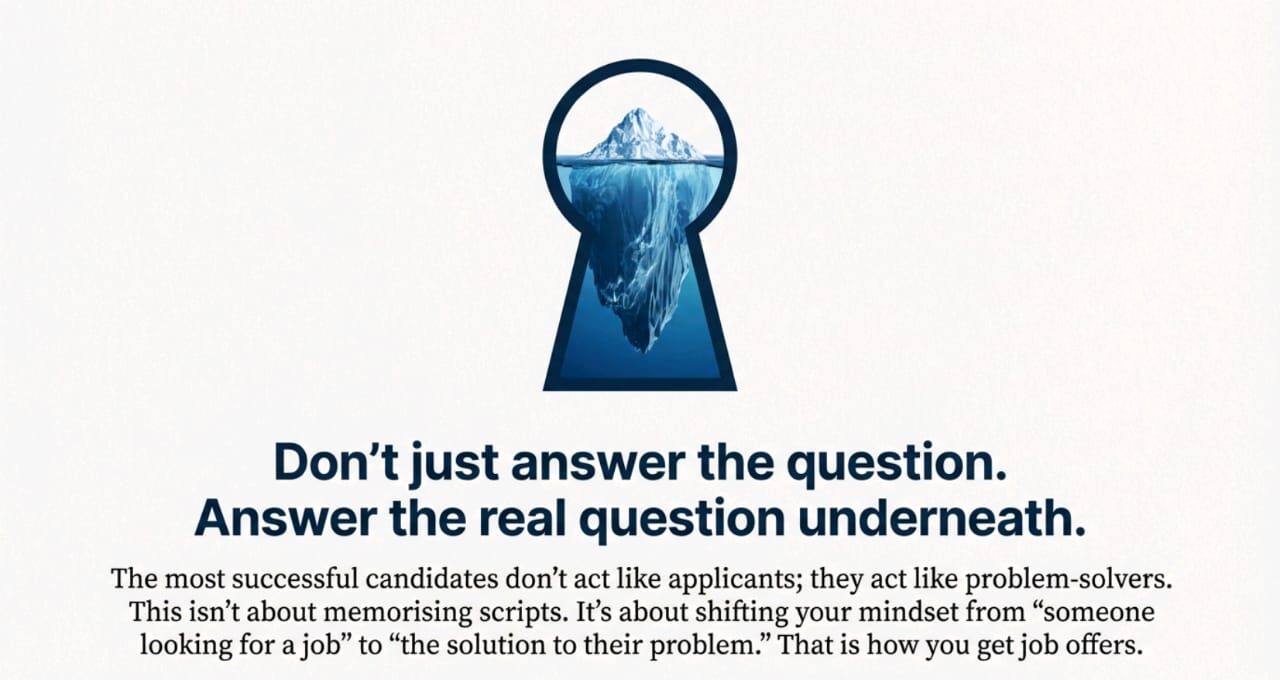
The common thread running through all seven hidden interview questions is this: successful candidates don’t act like applicants; they act like problem-solvers. This fundamental mindset shift moves you from passively answering questions to actively demonstrating how you can contribute to the organization’s success.
This isn’t about memorizing scripts or gaming the system. It’s about genuinely understanding the business needs behind each question and addressing those concerns head-on. When you make this shift, you transform from one of many candidates into the solution they’ve been searching for.
Preparing Your Foundation for Interview Success
Before you can effectively answer these hidden interview questions, you need a solid foundation. That foundation starts with a resume that positions you as a strategic problem-solver from the first glance. Your resume is often your first interview, and it needs to tell the same compelling story you’ll share in person.
Consider investing in professional resume services that understand current hiring trends and can help you position your experience effectively:
- Resume.io offers intuitive, AI-powered resume builders with industry-specific templates that help you create ATS-friendly resumes that get past automated screening systems.
- TopResume provides professional resume writing services with certified writers who understand how to translate your experience into achievement-focused narratives that resonate with hiring managers.
- TopCV delivers expert resume reviews and rewriting services that identify gaps in your current resume and strengthen your professional story.
- TopStack Resume specializes in tech and professional resumes, ensuring your technical skills and strategic thinking are presented in ways that appeal to modern employers.
These services can significantly improve your chances of getting to the interview stage in the first place. Once you’re there, understanding these hidden questions gives you the advantage you need to convert interviews into offers.
Putting It All Together: Your Action Plan
Now that you understand the seven hidden interview questions and the real concerns behind them, here’s your action plan for interview success:
- Audit your resume: Ensure it tells a story of problem-solving and results, not just responsibilities. Consider getting a professional review if you’re not getting interview callbacks.
- Research thoroughly: Before any interview, research the company’s challenges, recent news, competitors, and industry trends. This knowledge will help you connect your answers to their specific needs.
- Prepare specific examples: For each of the seven questions, prepare at least two concrete examples from your experience that demonstrate results and learning.
- Practice the winning formulas: Rehearse your answers using the structures provided, but don’t memorize them word-for-word. You want to sound natural and conversational, not scripted.
- Prepare thoughtful questions: Write down 5-7 intelligent questions you can ask at the end of the interview. Choose the most relevant ones based on how the conversation unfolds.
- Shift your mindset: Remind yourself before each interview that you’re not just looking for a job—you’re evaluating whether this company’s problems match your problem-solving abilities.
Final Thoughts

Job interviews don’t have to be anxiety-inducing interrogations. When you understand what interviewers are really asking and prepare accordingly, you transform the experience into a strategic conversation between professionals. You’re no longer hoping they’ll choose you; you’re both determining if there’s a mutual fit.
The seven hidden interview questions we’ve explored reveal the deeper concerns every hiring manager has: Can you do the job? Will you stay? Do you care? When you address these underlying concerns with specific examples, genuine enthusiasm, and strategic thinking, you position yourself miles ahead of candidates who only answer the surface questions.
Remember, landing your dream job starts long before you walk into the interview room. It starts with a resume that opens doors, continues with thorough preparation, and culminates in interviews where you demonstrate not just competence, but partnership potential.
Take the time to strengthen your foundation with a professionally crafted resume through services like Resume.io, TopResume, TopCV, or TopStack Resume. Then practice answering the real questions behind the surface questions. With this combination of preparation and strategic thinking, you’ll not only get more job offers—you’ll get offers for roles where you can truly thrive.
The next time an interviewer asks you one of these common questions, you’ll smile knowingly. Because while other candidates are answering what they think was asked, you’ll be addressing the real concern underneath. And that’s exactly how you get job offers.